

Do Cultures Dream?
The future is not built from nothing. It is haunted by the desires of those who came before it.

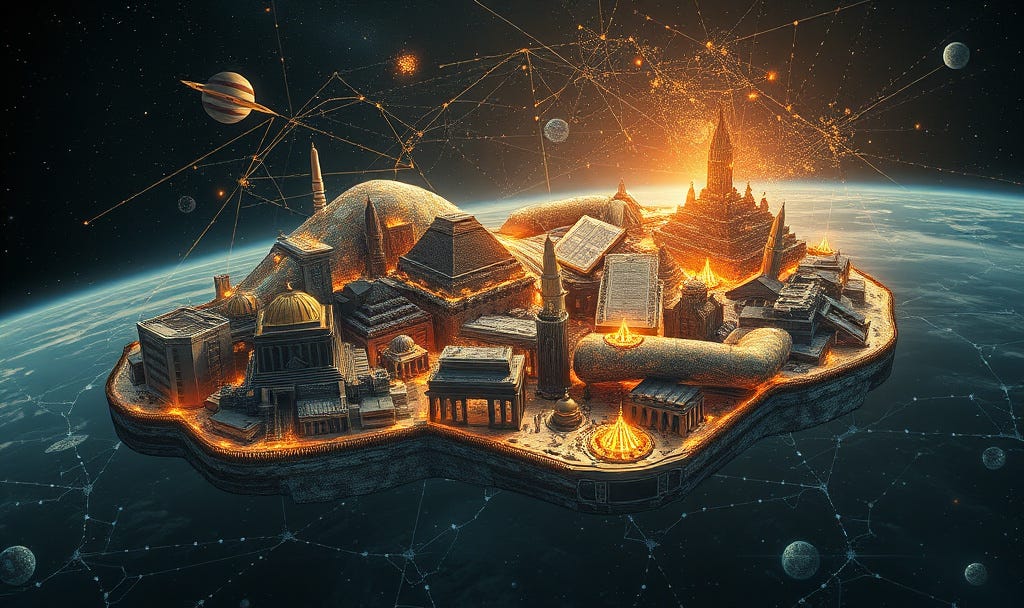
Every night we dream. In our nights, the conscious mind loses it’s grip and something deeper begins to take on the images of our subconscious. Desires transform into stories told about these desires. Fears become monsters. Emotions become landscapes such as how water is shown in dreams relate to the mind’s emotional states.
A culture is often described as a collection of customs, beliefs, traditions, and values. Yet that definition doesn’t feel complete. Cultures behave like something more alive than a simple collection of ideas. They can evolve, adapt, remember and forget. They become obsessed with certain themes and return to them again and again.
A civilization may spend generations imagining a possibility before it manifests. A dream about flight existed long before aircraft. A dream about being able to speak across vast distances existed long before telephones and the internet. A dream of immortality continues to shape medicine, technology, and our search for longer lives.
The future is not built from nothing. It is haunted by the desires of those who came before it.
Some of culture’s dreams die. Others survive long enough to become reality. This is something that should make us wonder : What exactly happens to belief? Modern science has opened the door to ideas about reality that would have sounded impossible a few centuries ago. Physicists debate on whether reality consists of information at it’s deepest level.
Some interpretations of quantum mechanics suggest a variety of possibilities much larger than the world we consciously experience. Researchers studying emergence have shown how simple interactions can generate complex systems that appear almost alive. None of these theories prove that beliefs become entities in alternate realities, but they do invite us to think beyond what we rehearsed in our minds as normal.
What if beliefs are more than private thoughts? What if they are more like patterns? What if every belief creates a structure within the landscape of possibility? The more attention, emotion, and meaning people invest into a pattern, the more influence it gains.
A story told once has a chance of disappearing. A story told over and over for a thousand years may shape an entire civilization.
Religions, nations, myths, archetypes, movements, and collective identities all begin as ideas. Yet overtime they acquire a strange kind of momentum. They begin influencing the people who created them. At a certain point, it becomes difficult to tell whether humans are shaping the story or the story is shaping humanity. Maybe this is how cultures dream. Not as a metaphor, but as a process. Millions of minds investing energy into recurring symbols until those symbols become forces that guide behavior, direct attention, and shape reality itself.
In this sense, every culture possesses a subconscious that comes alive by manifesting as the dreams that came true of the future. It possesses it’s hopes, fears, heroes, monsters, and its unfinished business.
Then, like the subconscious of an individual, it often speaks through symbols such as a nation obsessed with expansion. Or a generation obsessed with freedom. An era haunted by collapse. These are not just political events. They might be dream motifs. Patterns emerging from a deeper layer of collective consciousness.
If this is true, then an important realization comes. The most powerful force shaping reality is not belief alone, It is embodied belief. A passive thought doesn’t contribute much. A lived belief changes worlds. When people align thought, emotion, action, creativity, storytelling, and ritual around a shared vision, they amplify its influence dramatically. Ideas gain power through participation.
This is why artists and storytellers matter. This is why myths survive. A civilization’s dream is sustained by those willing to carry it forward. Every song, book, painting, movement, invention, prayer and act of devotion feeds something larger than itself.
Attention is not simply observation, it’s nourishment that feeds the foundations of a culture’s dream.
Where attention flows, cultural dreams grow stronger. Which means every generation inherits a responsibility. Not only is the responsibility to receive dreams, but to choose which dreams deserve continuation. Some inherited dreams lead to liberation, Others lead to destruction. Some dreams are worth feeding, others are worth letting them starve. The future will inherit whatever we repeatedly give our energy to in our lives today. That may be the most important realization of all.
So, maybe cultures dream and maybe they always have. Maybe the myths of the past, and the possibilities of the future are all expressions of the same ongoing process : a civilization imagining itself into existence. If that is true, then the question is no longer whether cultures dream. The questions to consider are : Whose dream are we living inside? What dream are we teaching the future to inherit?
If this sparked any curiosity, feel free to support The Crowned Sun Collective.